Skip to content

European Chinese Law Research Hub

  • Home
  • About Us
  • Follow Us
European Chinese Law Research Hub

Tag: Speech Regulation

The Great Firewall Gets a Passport: How China’s Censorship Travels

9. July 2026

A paper by Ge Chen

Many people still picture censorship in China as something that happens “over there”: blocked websites, deleted posts, and rules enforced inside China’s borders. That picture is increasingly outdated. Today, China’s censorship is not only domestic. It is also transnational in effect, shaping what can be said in other countries, by non-Chinese actors, without always looking like formal “extraterritorial law”.

My recent article asks a simple question: how does a party-state turn domestic speech control into cross-border influence, and do so through law, regulation, and “normal” governance tools rather than just blunt coercion?

The starting point is that China’s speech control has become more systematic in the past decade, tied to legal and institutional changes that place the Chinese Communist Party (CCP) more openly at the centre of the state’s governing structure. This matters because a regime that wants its speech norms to travel needs more than censorship orders. It needs a framework that looks like legitimate regulation with rules, agencies, and a story about why restrictions are “necessary”.

The article traces three legal “routes” through which censorship travels.

Political pressure beyond borders
One route is what many observers now call transnational repression: pressure on dissidents and diaspora communities outside China. This can include intimidation, harassment, and attempts to deter protest and criticism overseas. A striking example discussed in the article is the reported interrogation of hundreds of followers of a prominent online dissident known as “Teacher Li”, which allegedly led to a large loss of followers on X after pressure was applied.

The point here is not only that these incidents happen, but that they sit within an expanding legal infrastructure including national security legislation and laws that explicitly imagine overseas countermeasures. In other words, transnational pressure is increasingly framed as part of “lawful” security governance.

Economic leverage that turns into speech control
A second route is economic. The mechanism is familiar: access to China’s market can be conditional, and those conditions often concern speech. The NBA controversy over Hong Kong is an obvious public example, but the deeper story is structural: global companies learn that compliance is not just about products, but also about how they talk (or do not talk) about China.

The article also looks at how speech-related sensitivities can enter business documentation and risk language, including pressure to avoid “negative” descriptions of China in overseas listings. The result is a kind of “self-censorship by compliance”: firms tone down language not because a foreign court orders them to, but because they anticipate regulatory or commercial retaliation.

Technology, data rules, and AI as censorship infrastructure
A third route is technological. Censorship becomes portable when it is built into data governance and compliance ecosystems — cybersecurity rules, data security regulation, and personal information governance — rather than relying only on blocking content.

The article discusses how China’s data and AI regulation increasingly merges speech control with surveillance capacity, and how rules on emerging technologies (including generative AI) can be used to enforce ideological “values” through technical design requirements.

Across these routes, a key theme is that censorship does not only silence. It also persuades. The article ends by describing a two-track logic: defensive censorship aims to deter criticism and limit access to dissent, while offensive censorship, backed by narratives of stability, growth, investment appeal, and technological competence, aims to promote the claim that authoritarian governance is superior.

Thus, transnational censorship works differently outside of China. It often travels through contracts, partnerships, funding ties, platform policies, business risk assessments, and perceived surveillance. That makes it harder to see, and harder to regulate under traditional free speech doctrine. If the Great Firewall once looked like a national border wall, it now looks more like a passport: it travels through governance tools that other systems recognise as ordinary: law, compliance, risk management, and technology standards. The full article develops this framework in detail and explores what it means for global freedom of expression.

That, in the end, is why the Great Firewall now needs a passport. It may be no coincidence that the U.S. State Department has recently said it is preparing a “Freedom.gov” tool aimed at helping users bypass censorship in places like China and Iran—an indication that “internet freedom” itself is becoming openly geopolitical.

The article How China Curbs Free Speech Beyond Its Borders: Legal Strategies of Transnational Censorship was published in the Journal of International Media & Entertainment Law. Dr. Ge Chen is Associate Professor of Global Media and Information Law and Director of the Centre for Chinese Law and Policy at Durham University. His research focuses on free speech and global constitutionalism, with particular attention to China. He has held academic positions at the University of Oxford, the University of Cambridge, and Yale Law School, and was previously a research associate at the Mercator Institute for China Studies, the EU’s leading China think tank. He is the author of Copyright and International Negotiations: An Engine of Free Expression in China? (Cambridge University Press, 2017), and the 2025 recipient of the Franklyn S. Haiman Award for Distinguished Scholarship in Freedom of Expression.

General Content Moderation, Extraterritorial law, Speech Regulation

Conjuring up Equality Rights? How China’s Statist Approach Fosters in an Emerging Global Regulatory Patchwork of Online Hate Speech

3. December 2022
A paper by Ge Chen
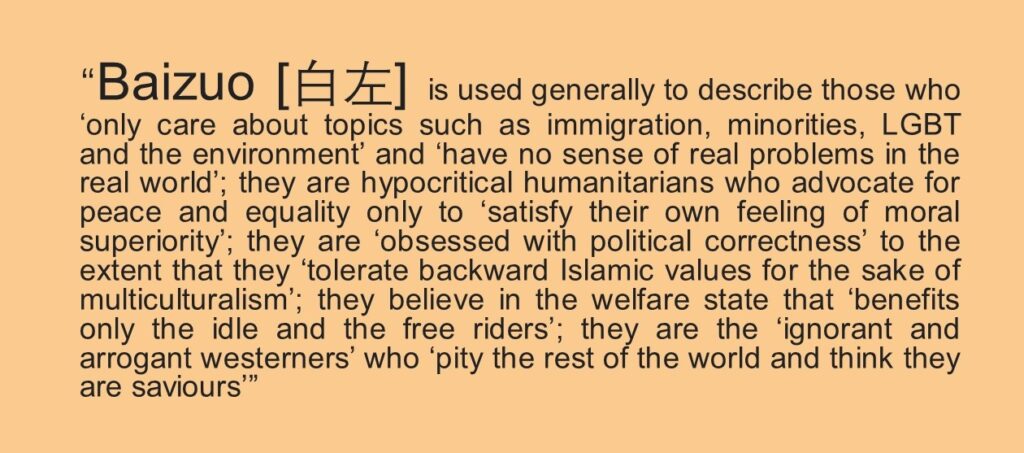
Definition by Chenchen Zhang (2017). Censorship on the Chinese internet often stops short of regulating the slander of those labelled as Baizuo.

Hate speech has almost never been a major legal issue in China. It is not until very recently that the need to regulate online hate speech as a criminal offence attracted more attention from legal scholars. On the plane of governance, the problem of potential tensions between different nationalities, religions, genders and perhaps regions is a politically sensitive item, albeit far from being the most sensitive one that triggers the nerve of the ruling party. In most cases, such potential tensions are glossed over either by the work of the “United Front” or by media censorship. Due to the prevalence of the authoritarian, Confucianist, and Great-Han culture, those tensions are likewise often ignored by many ordinary Chinese: in their eyes, such issues range from being petty and unimportant to non-existent. After all, highlighting those issues marks profound deviation from a “harmonious” society in Confucianist illusion.

Yet those tensions do exist as in any other society. And speech expressive of hatred and resentment of anything in those categories is ubiquitous in China – online or offline. The reason why hate speech is neither a legally defined term nor anywhere properly regulated in Chinese law is that hate speech is simply ranked very low among various types of political speech in a highly authoritarian system of speech regulation. Where political speech lacks real constitutional protection, hate speech will not even be recognised as such. However, speech regulation is real and, by its very definition, hate speech does fall sometimes into the purview of such regulation. One of the main legal sources that captures hate speech regulation is China’s Criminal Code (Arts. 249 & 250). Other recent sources include numerous administrative regulations on publication as well as the new Civil Code (Art. 1183).

The reason why hate speech is neither a legally defined term nor anywhere properly regulated in Chinese law is that hate speech is simply ranked very low among various types of political speech in a highly authoritarian system of speech regulation.

Importantly, this emerging patchwork of hate speech regulation looms large amid a bunch of new online hate speech regulations in liberal democracies, where the constitutional protection of free speech is sacrosanct but may be circumscribed by equally important priorities. The constitutional and legal contours of speech protection and regulation, however, are at variance among those countries, and distinctly so between the US and Europe. At any rate, equality concerns are a rising factor that could puzzle even lawmakers and courts when it comes to a potential conflict between freedom and equality. So far the regulation of online hate speech has been a topic of controversy among politicians, lawyers, activists and media. While many are zealous followers of, say, minority protection and gender equality, others cast doubt on the overemphasis on equality-related considerations that could buttress authoritarians’ “benevolent violation” of personal freedom – here, in particular, freedom of expression.

Thus, it is highly interesting to look into the regulatory area of online hate speech through a comparative lens. Can those rising equalitarian considerations in the constitutional regulation of hate speech lend a hand to an authoritarian regime in legitimising its legal technique of restricting political speech in a more nuanced, less noticeable manner? At least, the notice and takedown regime is highly identical to that in western hate speech laws such as the German Network Enforcement Act (‘NetzDG’). But there are more advanced restrictive measures of political speech such as a manipulated campaign of unleashing hateful speech against liberalism itself. A leading example is the online, public disparagement of “White Left” (baizuo) which has had impingement on any liberal-minded speakers that may articulate their criticism of the mainstream ideologies or governance models.

This paper explores this unique pattern of regulating online hate speech in alignment with the prevailing regulatory framework in Europe and the US. The paper analyses the emerging regulatory patchwork of hate speech regulation in China which builds on the regulation of political speech in China and addresses the ways in which European and US approaches have informed Chinese law, though the latter are used in different ways within an authoritarian constitutional order characterised by demoralised pragmatism and interest-driven administrative law. The paper develops a case study of the disregulation of “white-left” commentators (deemed to represent Western liberalism), which raises questions about the connection between support for particular modes of regulation against the background of a particular political system, with differing roles for the state, private actors, and media organisations.

The paper “How equalitarian regulation of online hate speech turns authoritarian: a Chinese perspective” was published in the Journal of Media Law. Ge Chen is Assistant Professor in Global Media & Information Law at Durham Law School. His main research interest is free speech in international and comparative perspectives. He was postdoctoral research associate and remains associate of the Centre for Intellectual Property and Information Law at the University of Cambridge. He was resident fellow (Fulbright nominee) and remains affiliated fellow of the Information Society Project at Yale Law School. He was Visiting Academic of the Programme for Comparative Media Law and Policy at the University of Oxford. He is the author of Copyright and International Negotiations: An Engine of Free Expression in China? (CUP 2017), a research monograph featured in Harvard Law Review.

General Hate Speech, Information Law, Internet Law, Speech Regulation

Recent Posts

  • The Great Firewall Gets a Passport: How China’s Censorship Travels
  • AI for China’s Courts: Training and Testing for the Socialist Rule of Law
  • Rule by Algorithm: When Code Displaces Law
  • Algorithmic Control and Judicial Conformity: How China’s Smart Courts Redefine Justice
  • China’s Export Control of Dual Use Items: From Multilateralism to Extraterritoriality

Tags

Adjudication Administrative Enforcement Administrative Procedure Arbitration Authoritarian Legality China International Commercial Court Chinese courts Civil Code Civil Law Civil litigation Communist Party Comparative Law Constitutional Law Content Moderation Contract Law Covid-19 Criminal Law Criminal Procedure Data Protection Democracy Digitalization Government Transparency Hong Kong Human Rights International Law Judges Judicial Reform Judicial Reforms Labour Law Law and Development Lawyers Legal Culture Legal History Migration One Belt One Road Open Public Data Public International Law Regulation Regulation of AI Rule by Law Rule of Law Smart courts Social Credit System Supreme People's Court Supreme People's Procuratorate

Subscribe to our newsletter…

...to be the first to learn about new blogposts.

Idealist by NewMediaThemes