Skip to content

European Chinese Law Research Hub

  • Home
  • About Us
  • Follow Us
European Chinese Law Research Hub

Tag: Civil Code

Children’s Tort Liability and Evolution of Chinese Tort Law in the Post-Codification Era

15. August 2025
A new paper by Yuanshi Bu

How do ordinary Chinese people think about justice? Tort law may provide an excellent lens through which to explore this question. Within tort law, the issue of children’s tort liability stands out as particularly illuminating, as it highlights the significant challenges families and schools face in raising, caring for, and educating children in China. Four years after the Chinese Civil Code (CCC) came into effect, more than 10,000 court judgments related to children’s tort liability have already been made available online. Thus, it came as no surprise that the Supreme People’s Court’s first judicial interpretation of the Tort Liability Book of the CCC devoted half of its content to children’s tort liability. After all, the CCC has codified six norms in this area, with three addressing children as tortfeasors and three pertaining to children as victims.

However, Chinese legal scholars often criticize the domestic approach to handling children’s tort liability and have made various proposals for improvement based on foreign models. To understand why these proposals have not been adopted by the judiciary, and to uncover the logic behind the development of Chinese tort law, I examined around 400 relevant court decisions. In recent years, big data analysis of Chinese tort law is becoming increasingly popular. However, given my interest in factual patterns and judicial reasoning, I found it more meaningful to review actual court judgments directly, despite the considerable amount of time associated with it. The judgments I examined revealed the following characteristics of the legal regime governing children’s tort liability:

First, the Chinese regime of children’s tort liability is characterized by a liability union in respect of a minor and his or her parents. This means that if children cause harm to others, both they and their parents are held liable. However, the liability of the child wrongdoer and that of their parents is considered one and the same. This stands in stark contrast to other jurisdictions such as the German one, where parental liability is separate from that of their children. For example, unlike under Chinese law, under German law parents are not liable if they have properly educated their children not to play with fire, and the children nevertheless did so and burned down a house. In addition, in the Chinese liability regime, even toddlers can be considered capable of committing tortious acts. For instance, liability was imposed on the parents of a 22-month-old toddler who ran over the victim’s foot with a buggy. In this sense, tort liability applies to children without a minimum age threshold. Parental liability is incurred automatically, regardless of whether the child is under the parents’ care, even when the harm occurs in a boarding school. A child wrongdoer’s family can be released from liability only if it can show that the harm was entirely caused by the victim or a third party. Under the current legal regime, grandparents in China, who often serve as primary caregivers for young children without emuneration, also face considerable liability risks.

Second, the harsh liability regime is mitigated by the fact that Chinese courts rarely assign 100% liability to child wrongdoers and their parents. Child victims are often held partially liable for their own injuries, regardless of their age. In one case, a nine-year-old child was injured by two other children (aged nine and eleven) who had built an improvised swing from strips of artificial grass on a mobile soccer goal at school, causing it to tip over. Although the victim had done nothing more than stand nearby, he was found 20 % at fault. In the eyes of Chinese judges, being at the wrong place at the wrong time already indicate a failure of the child or the parents.

Third, the above-mentioned finding basically holds true also with regards to harms occurring in schools. While many relevant cases involve minors colliding and losing their (milk) teeth, serious incidents also occur in which victims have lost their eyesight or even their lives. To reduce their exposure to liability, many schools, particularly elementary schools, do not allow pupils to leave the classroom during breaks, except to use the toilet. Additionally, an increasing number of school services, such as transportation and lunch, are being outsourced.

One might ask why parents and schools do not simply take out liability insurance to solve the problem. The answer is that ordinary Chinese still tend to try their luck, at least up to now. In most cases, neither the victim nor the tortfeasor has liability insurance. Even worse, medical coverage is particularly precarious for children: 60.44 % of the treatment costs are reportedly born by the families. This is why people sometimes litigate over relatively minor injuries. Confronted with high vulnerability of the child wrongdoer and child victim in coping with accidents, courts in China often have no choice other than distributing losses among all involved parties to avoid social discontent. In this sense, tort law in China is still loyal to the conventional primary purpose of compensating victims.

Lastly, through reading the judgments, a discrepancy between legal scholarship and the judiciary regarding the perception of what constitutes deficiencies in tort law has become apparent. In fact, it is still extremely rare for Chinese scholars to consider court rulings when researching this topic. Instead, emphasis is placed on comparative law. I believe that if the goal of Chinese legal scholarship is to build an autonomous knowledge system and thereby provide guidance to the legislature and judiciary, more attention must be paid to court practice in China and the rationale behind adjudication patterns. So far, due to the social, economic, and political context in which Chinese tort law operates, it has followed a rather need-based and piecemeal path.

The full paper, titled “Evolution of Chinese Tort Law in the Post-Codification Era: A Comparative Study Based on Children’s Tort Liability”, is published in the German Journal of Chinese Law (in English), vol. 2/2025. Yuanshi Bu is a Professor and the Director of the Chair of International Economic Law with a Focus on East Asia at the University of Freiburg. She can be contacted at asien@jura.uni-freiburg.de.

General Civil Code, Judgments, Tort Law

Is Chinese Law Prepared for AI Songs?

5. December 2024
A paper by Yang CHEN
Credit: Free Malaysia Today

Technology is racing ahead. And the music you hear fills you with dread—Is it really the voice you know, or just an AI putting on a show? AI songs stand at the crossroads of innovation and controversy. Recently, AI-generated songs that clone the real voices of celebrities have sparked intense debate globally. In China, songs mimicking famous Chinese singer Stefanie Sun’s voice have become particularly controversial. Fans create tracks in her style, despite her never having sung them, and share these on social media platforms without her consent. A popular tool for this is “SO-VITS-SVC,” an open-source program that can clone celebrity voices, enabling anyone to create an AI model that can “sing” in the trained voice.

Against this backdrop, the article first examines whether current Chinese law is resilient enough to adapt to new technology in granting celebrities control rights over these AI songs. In many jurisdictions, a person’s voice is seen as part of their identity and deserves protection. In China, it is widely accepted that a person’s unique voice is part of their identity, which entails certain personality interests, especially those related to dignity. However, scholars disagree on whether the law should give a separate right to voice or just recognize the personality interests connected to it. The PRC Civil Code, promulgated in 2020, took a small step in protecting individuals’ voices by acknowledging personality interests in unique voices, rather than creating a separate right to voice. This distinction between standalone rights and recognized personality interests is significant under the Chinese civil law system, as rights typically receive more systematic and extensive protection than personality interests. By interpreting the Civil Code, this article concludes that it is feasible to construe the relevant provisions in a way that grants celebrities control rights over AI songs.

However, apart from conducting doctrinal and descriptive analysis, this article delves into the larger theoretical question of whether at all and when celebrities should be allowed to control these AI songs. Should we adopt a strict interpretation of the Civil Code which is clearly favourable to celebrities? I draw on several theories, including incentive rationale, economic efficiency, labor theory, individual liberty and dignity interests, consumer welfare, and dilution theory, to answer the question. Most of these theories do not offer justification for celebrities to fully control AI songs created on the basis of their works. For example, while utilitarianism provides reasons for allowing individuals to control their own voices, doubts remain as to whether identity holders should receive all the benefits derived from their voices. Labor theory acknowledges the contribution of voice holders to AI songs but also emphasizes the contributions of other market participants, making absolute control questionable. Consumer protection is one potential justification for celebrities to control their voices in AI songs, as it could prevent confusion over the authenticity of the song on the part of the consumers. However, confusion is not typically an issue in the AI songs context, and there are more direct ways to address any potential ambiguity over a song’s creator. Some scholars invoke dilution theory to justify control rights over AI songs, arguing that it prevents weakening the association between celebrities and their voices. Yet, this article doubts whether such dilution by AI songs actually occurs in practice. Ultimately, the only plausible justification lies in dignitary interests, which may support a creator’s limited but not absolute control over AI songs.

None of these theories provides strong reasons to interpret the relevant provisions of the PRC Civil Code in the manner that is strongly favourable to the artists, as is the result of mere doctrinal analysis shown above. In China, where laws focus on dignitary interests, policymakers might naturally want to expand personality rights. However, while it is important to consider these dignitary interests of artists, the reference to other theories can help balance the many different interests involved. It is recommended that policymakers consider all these theories instead of just focusing on one or two.

Building on the doctrinal view and the discussion of relevant theories, this article then puts forward a short proposal for policymakers to serve as initiation for debates on future legislation. First, a general right to control AI songs is recommended to protect individual dignity and liberty of artists. Second, while decision-makers may be inclined to grant broad control rights as a way to reward the invested labor on the part of artists, they should also consider the contributions of other participants and design more balanced, qualified rights. Third, to prevent consumer confusion over the authenticity of songs, policymakers can implement more direct measures, such as requiring platforms or content uploaders to display clear indications for AI-generated products, rather than establishing new control rights. Finally, any general right to control AI songs based on dignitary interests should also take the public interest into account, incorporating exceptions for selected situations. Building on these insights, the article further proposes specific reform suggestions for the PRC Civil Code.

The question of whether celebrities should have rights to control AI songs is just one of many challenges policymakers face regarding personality rights in the new technological age. This article warns against the trend of sloppily broadening the scope of personality rights in China as a solution whenever there are issues arising from new technology. It recommends decision-makers to consider different theories and ideas when addressing new legal and technological issues to form a more balanced solution.

The paper “Is Chinese Law Well-Prepared for AI Songs? A Note of Caution on the Over-Expansion of Personality Rights” is published in the Cardozo Arts & Entertainment Law Journal Vol. 42(2), 2024 (SSRN draft available here). The author thanks Kaijing XU, a JD student at CityU School of Law, for the research assistance in preparing this post.
Yang Chen is an assistant professor at the City University of Hong Kong. He has received an LL.B from China University of Political Science and Law, an LL.M from London School of Economics, and another LL.M and SJD from the University of Pennsylvania Carey Law School. Yang works primarily in the areas of intellectual property law, with a keen interest in particularly trade secrets law and right of publicity. He also researches trademark law and copyright law. His works have appeared in several journals such as the Columbia Journal of Law and the Arts, the University of Pittsburgh Law Review, and the University of Pennsylvania Journal of Business Law.

General Civil Code, Civil Law, Regulation of AI

Embedding Private Law into the Green Transition: The Case of the ‘Green Principle’ under the Chinese Civil Code

14. January 2024
A new paper by Jie Ouyang
‘Ecological civilisation’ has been a core pillar of the Communist Party of China’s political agenda in recent years. It highlights the growing importance of balancing economic growth with environmental protection. Environmental degradation comes from economic growth, economic growth relies on market functioning, and the market runs on private contracts. Private law doctrines, such as freedom of contract and limited liability of corporations, provide the legal and institutional framework that enables market actors (especially those with stronger bargaining power) to reap the profits from market transactions, while legally outsourcing the environmental externalities to the general public. Think of a cheap pair of jeans – it is cheap because its enormous environmental costs are not factored into its pricing and such pricing is possible because contract law allows/encourages us to only care about our immediate party (‘privity of contract’).

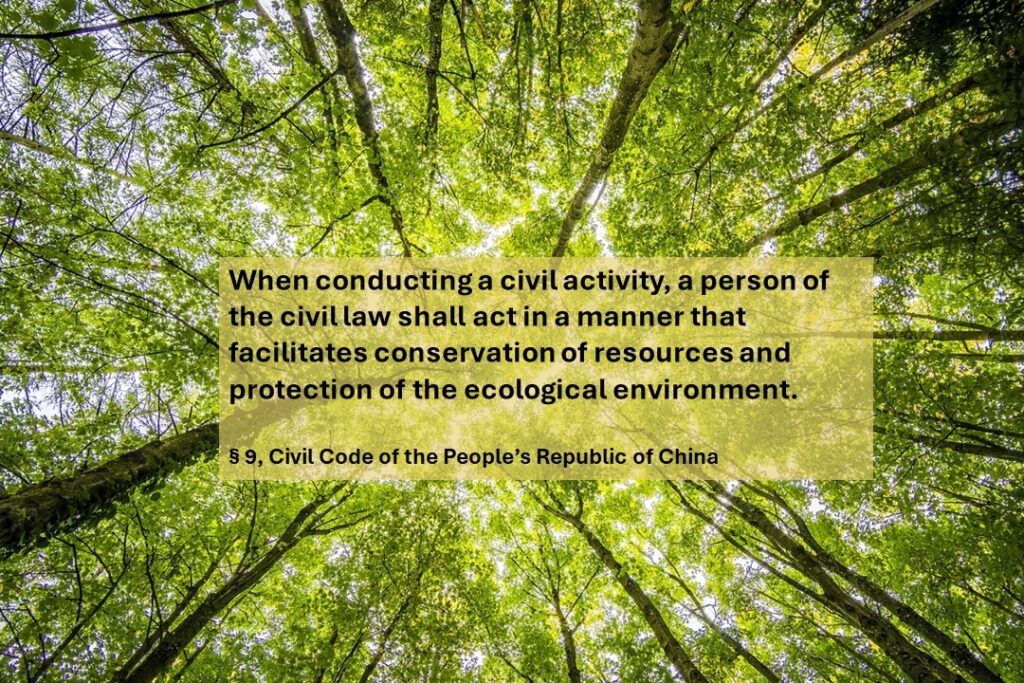
Granted, public environmental regulation poses significant limitations to private dealings. But if private law causes the problem in the first place, maybe we could also think about how we can address the problem from within private law. In the civil codification project since 2017, though the Chinese legislators refrained from a complete overhaul of existing civil legislation, they did endeavour to reconcile the tension between private autonomy and public environmental good. Among others, Art. 9 of the Chinese Civil Code (‘CCC’), which is often known as the ‘green principle’, prescribes sustainability as an overarching principle of private law. It reads: When conducting a civil activity, a person of the civil law shall act in a manner that facilitates conservation of resources and protection of the ecological environment.

This principle is highly abstract – just as abstract as other established principles in private law such as good faith and public policy. Judges in China, however, have not shied away from engaging with this principle, often in a rather creative way. For example, if I plant trees on your land illegally, you would think that you can rightfully ask me to cut them down. But several courts[1] said no – as trees could help prevent soil erosion. In another case,[2] the court reversed a homeowner association’s resolution that prohibited a homeowner from installing an electric vehicle charging station in the parking lot. The decision highlighted the scientific fact that electric cars can reduce fossil fuel consumption and have zero tailpipe emissions. (A side note: the Chinese authority has been actively promoting electric cars since the early 2000s.)

The green principle can be read as an attempt to align private law with the Constitution, which in the eyes of Chinese jurists is the ‘mother law’ that gives birth to other fields of law. Art. 26 of the Chinese Constitution provides: ‘The State protects and improves the environment in which people live and the ecological environment. It prevents and controls pollution and other public hazards.’ The green principle is even part of a broader political project, namely ecological civilisation, which radiates to the entire state apparatus. For example, the Supreme Court has been actively mobilising local courts to provide ‘judicial services’ in order to achieve carbon peak and carbon neutrality, which includes the imperative of ‘correctly applying the green principle’. Ecological civilisation is not only the task of the state as Art. 26 of the Constitution seems to indicate. With Art. 9 CCC, it is indicated that every private person, too, is not part of the transition towards a more sustainable future.

The green principle represents a welcome approach to opening up private law doctrines for environmental concerns. But many actually find such a politically laden principle disruptive to the system of private law. In their eyes, private law centres around interpersonal autonomy and deals with direct exchanges between the parties themselves. Of course, they defend party autonomy and demarcate a clear boundary of private law for a reason – the tentacles of the party-state are already way too present almost everywhere. Sure, we need a proactive and responsive state to fight climate change and save the environment, but what if the state itself is inconsistent in its commitments? For example, China was building significantly more new coal plants in 2022 to address the electricity shortage and was turning forests into farmland to ease the food crisis. Sure, we need to involve private parties to internalise the environmental costs, but what if the green principle is instrumentalised as another gateway for party politics to creep into civil society? For example, the word ‘resources’ under Art. 9 CCC has not only been interpreted as ‘ecological resources’ but also as ‘social resources’[3] and ‘judicial resources’,[4] which carry significant indeterminacy that can only be determined by the judges’ political sensitivity. The green principle tells a rosy story of an ecologically responsive private law of the 21st century, but, what will the real outcome be?

The article ‘Unleashing the Green Principle in the Chinese Civil Code: Embedding Private Law into the Green Transition’ has been published in the Journal of European Consumer and Market Law, Volume 12, Issue 5 (2023) pp. 203 – 208. Jie Ouyang (LinkedIn, SSRN) is a PhD candidate and Lecturer at the University of Groningen. His research primarily focuses on European private law (especially European consumer law), fundamental rights and sustainability.


[1] For example, Xixian Xinyang Primary People’s Court of Henan Province (2017) Yu 1528 Civil-First No. 4405 (河南省信阳市息县人民法院(2017)豫1528民初4405号民事判决书); Suining Primary People’s Court of Hunan Province (2017) Xiang 0527 Civil-First No. 969 (湖南省绥宁县人民法院(2017)湘0527民初969民事判决书).

[2] Jing’an Primary People’s Court of Shanghai Municipality (2018) Hu 0106 Civil-First No. 3616 (上海市静安区人民法院(2018)沪0106民初3616号民事判决书).

[3] For example, Ziyang Intermediate People’s Court of Sichuan Province (2018) Chuan 20 Civil-Final No. 427 (四川省资阳市中级人民法院(2018)川20民终427号民事判决书).

[4] For example, Tai’an Intermediate People’s Court of Shandong Province (2019) Lu 09 Civil-Final No. 3147 (山东省泰安市中级人民法院(2019鲁09民终3147号民事判决书).

General Civil Code, Environmental Protection, Green Principle, Green Transition

The Enforcement of Mandatory Rules against Illegal Contracts

24. June 2022
A new paper by Bingwan Xiong and Mateja Durovic
Lottery Kiosk at Xuzhou Station. Under Chinese law, lotteries are considered gambling and thus illegal -with two major exceptions: the China Welfare Lottery and the China Sports Lottery.
Photo by MNXANL licensed under Creative Commons Attribution-Share Alike 4.0 International.

In the past, Chinese courts tended to directly invalidate illegal contracts, thus possibly tolerate opportunistic behaviour sometimes. Article 52(5) of the 1999 Contract Law provides that a contract is void if it violates a mandatory rule prescribed by law or administrative regulation. Empirical research shows that by April 2014, in 355 of 453 cases concerning Article 52(5) of the Contract Law, the contract was ruled void.[1]

This practice underwent a change with the compilation of the Civil Code, where Chinese scholars sought to establish better coordination between the nature of private law and its attached public or regulatory facet. Building on a 2009 judicial interpretation that introduced a classification of mandatory rules, Article 153 of the new Civil Code stipulates a doctrine of defining mandatory rules with different levels of restrictions, with the aim of relieving the state’s restraint on the transition of economy. In result, a violation of mandatory rules may now render the contract involved void ab initio, voidable or still valid, depending on the significance of illegality defined by the law.

This change of jurisprudence successfully reversed the courts’ strong stance on the invalidation of contracts, giving them much more discretion in deciding the nature of mandatory rules and the effect on contracts. The reform also aligns the treatment of illegal contracts with the general trend in other jurisdictions. Nevertheless, we argue that across jurisdictions, this doctrine is merely targeted at the connotation of mandatory rules and the theoretical effects on contracts. Scholars and judges fail to equally emphasise the enforcement of the law against the contractors after upholding the validity of their illegal contracts. In other words, they end the debate within the realm of private law and simply assume that thereafter competent regulatory agencies would duly resolve the harm of illegality.

In our paper, we look into the case of the regulation of the lottery tickets sales on credit. As per Article 18 of China’s Lottery Regulation, no lottery may sell lottery tickets on open account or credit. Such a deed may result in imposed suspension, confiscation plus fines, and punishment on the person in charge as per Article 39. Armed with the new jurisprudence that not all kinds of illegality shall render contracts void and null, Chinese civil courts tend to uphold the validity of lottery sales on credit. Though this saves the innocent party from the loss because of the invalidation of the contract, the problem is, without the following actions of administrative organs, justice stops at the decision in court and the mandatory rules are not equipped with administrative enforcement power.

We find that the major obstacle is information asymmetry between courts and regulatory agencies: not only would the contracting parties not expose the illegal deal in fear of punishment or losing their interest. Also, the courts fail to actively transmit such information to the responsible departments, despite the Supreme People’s Court of China formally encouraging local courts to issue judicial proposals to regulatory agencies.

Empirical studies show that judges seldom issue judicial proposals about their cases to regulatory agencies due to their heavy workload, worries of engaging in improper judicial interference and a lack of rewarding incentives. As it encourages contracts and prevents opportunistic behaviour, we suggest to uphold the current jurisprudence about illegality, and further propose to establish a better systematic interplay among courts and regulatory agencies. This might be achieved through institutional reforms and technological solutions that help forward information of illegal transactions so it can serve the ultimate objective of enforcing the law.

[1] Ye Mingyi 叶名怡 (2015) Empirical Research of Invalidation of Illegal Contracts in China (我国违法合同无效制度的实证研究), Science of Law (法律科学) 6, 120.

This paper by Bingwan Xiong & Mateja Durovic The Enforcement of Mandatory Rules against Illegal Contracts was published in the Asia Pacific Law Review.

Bingwan Xiong is Associate Professor at School of Law, Renmin University of China. He is also Senior Research Fellow at Renmin University Center for Civil and Commercial Law. He obtained his PhD degree from Renmin University and LLM degree Harvard University. Email: bxiong@ruc.edu.cn.

Mateja Durovic is a Reader in Contract and Commercial Law, having joined The Dickson Poon School of Law in July 2017. Prior to joining King’s, he was Assistant Professor (2015‐2017) at the School of Law, City University of Hong Kong. He holds a PhD and LLM degrees from the European University Institute; LLM degree from the University of Cambridge; and an LLB degree from the University of Belgrade. Email: mateja.durovic@kcl.ac.uk

General Administrative Enforcement, Chinese courts, Civil Code, Contract Law, Illegal Contracts

Recent Posts

  • When Algorithms Meet Justice: A Deep Dive into AI-assisted Criminal Proceedings in China
  • Big Data Cannot Answer All Questions About Chinese Courts
  • The Iron Fist in a Digital Glove: How the CCP Manages Its Members with Apps
  • Smart Court, Smarter Party: A Necessary but Incomplete Interpenetration
  • Children’s Tort Liability and Evolution of Chinese Tort Law in the Post-Codification Era

Tags

Administrative Enforcement Administrative Litigation Administrative Procedure Anti-Monopoly Law Arbitration Authoritarian Legality Big Tech China International Commercial Court Chinese courts Civil Code Civil litigation Communist Party Comparative Law Constitutional Law Contract Law Covid-19 Criminal justice Criminal Law Criminal Procedure Data Protection Democracy Digitalization Government Transparency Hong Kong Human Rights International Law Judges Judicial Reform Judicial Reforms Labour Law Latin America Law and Development Lawyers Legal History Migration One Belt One Road Open Public Data Public International Law Regulation Regulation of AI Rule by Law Rule of Law Smart courts Social Credit System Supreme People's Court

Subscribe to our newsletter…

...to be the first to learn about new blogposts.

Idealist by NewMediaThemes