This is contribution #2 in our series on SMART COURTS AND SMART GOVERNANCE IN CHINA, outcome of our workshop in July 2025 at Cologne University.
In our daily lives, there’s an app for almost everything—ordering food, tracking fitness, managing work. But what if there was an app for political loyalty? For the Chinese Communist Party (CCP), this isn’t a hypothetical question. It’s a core part of its strategy for governing in the 21st century. Through a massive initiative known as “Intelligent Party Building” (智慧党建), the CCP is rolling out digital platforms to manage, educate, and discipline its 95 million members.
My research explores how this digital push is reshaping the very nature of power within the Party. It is not just about efficiency; it is about deepening control. The Party aims to achieve two seemingly contradictory goals at once: build a more modern, responsive bureaucracy while simultaneously reinforcing absolute top-down authority. This creates a new, powerful dynamic of internal governance in the digital age.
The Two Faces of State Power: An Iron Fist and a Nervous System
Despotic Power: This is the “iron fist”—the state’s ability to make decisions and issue commands without negotiation. It’s top-down, coercive, and absolute. Think of it as power over society.
Infrastructural Power: This is the state’s “nervous system”—its actual capacity to penetrate society and carry out its plans. It relies on logistics, institutions, and technology to get things done. It is power through society.
Historically, regimes were often strong in one of the types of power but weak in the other. For example, an ancient empire might have immense despotic power (the emperor’s word is law) but weak infrastructural power (it is hard to actually collect taxes in a remote province). Modern democracies often have strong infrastructural power (efficient services) but weak despotic power (leaders are constrained by law and public opinion).
The CCP under Xi Jinping, however, is trying to maximize both. “Intelligent Party Building” is a prime example of this ambition, using digital tools to build a highly efficient administrative nervous system that also serves a powerful iron fist.
Inside the “Party-Building Cloud Platforms”
So, what do these apps and platforms actually do? While they vary locally, they generally focus on four areas:
Digital Dossiers and Performance Tracking: The traditional paper dossier (dossier), a lifelong file tracking a person’s political behavior, is going digital. These platforms create a permanent, tamper-proof record of a member’s participation in Party activities. Poor performance can trigger warnings, public criticism, or even negative entries in their file that could impact their career.
Ideological Education on Demand: The platforms deliver a constant stream of ideological content. This includes live-streamed lectures, articles from state media, and materials from official education campaigns. To ensure engagement, members are often tested with gamified quizzes where they can earn points and compete on leaderboards.
Gamifying Loyalty: The platforms borrow heavily from popular apps to keep users engaged. For instance, the famous “Study the Great Nation” (学习强国) app rewards users with points for reading articles about Xi Jinping or watching videos of his speeches. This subtly transforms political indoctrination into a daily habit, much like checking social media.
Digitizing Bureaucracy: Beyond ideology, these platforms are also practical office tools. They handle routine tasks like paying Party fees, managing announcements, and approving leave requests. By integrating with daily work, they ensure the Party’s presence is not just a separate political activity but is embedded into the fabric of everyday professional life.
A Double-Edged Sword of Digital Control
The true innovation here is not the technology itself—many of these features mimic existing corporate collaboration tools like Ding Talk or WeChat Work. The innovation lies in its dual-use application for political control.
The very same feature that enhances infrastructural power (e.g., efficiently collecting data to provide personalized educational content) is used to wield despotic power (e.g., using that same data to monitor and punish members for insufficient engagement). A tool designed for convenience also becomes a tool for surveillance. A gamified quiz that makes learning “fun” is also a mechanism for ideological enforcement.
Ultimately, the CCP’s push for “Intelligent Party Building” reveals a fundamental tension. While it seeks to modernize its internal management to become more efficient and responsive, it remains unwilling to give up the coercive, top-down control that defines its Leninist roots. The result is a system where the iron fist is now wearing a digital glove, able to reach further and grip tighter than ever before.
Ningjie Zhu is a researcher at the Center for Advanced Security, Strategic and Integration Studies (CASSIS) at the University of Bonn. You can reach him at nzhu[at]uni-bonn.de.
China has given this movement a name—or at least rebranded the product of the alignment of technology and the courts: Smart courts, zhihui fayuan 智慧法院. The name suggests an alignment on the ground that is both linguistic and textual in the operational spaces of courts. Over the last decade or so, and through its Supreme People’s Court, Chinese officials have led a national effort to modernize the judicial system through the use of emerging technologies. Like other modernization pathways elsewhere, the goals include enhancing access to justice and ensuring that access provides pathways toward just outcomes. Since December 2024, these efforts also include an artificial intelligence platform to help judges improve work efficiency.
But names sometimes are a distraction. And that appeared to be the case with Chinese smart courts. The name became a vessel into which people could pour their larger fears about the transformations they feared most—that the people would no longer be their own masters but would serve technology even as technology appeared to serve them. It is no surprise, then, as Susan Finder relates in her examination of the Supreme People’s Court 2024 Work Report to the National People’s Congress, that the term “smart courts” appears to have been dropped.
Nevertheless, “smart courts” have become not merely a symbol of digital reform but a mirror reflecting deeper ideological and systemic transformations. What appears at first to be a techno-administrative modernization effort quickly reveals itself to be an exercise in high-stakes governance theory. The central question I pursued: Can a digitally advanced judiciary maintain alignment with a ruling party that is not itself digitally transformed? In other words, can a smart court operate effectively without a smart Party?
From Robot Courts to Zombie States?
The study of “smart” or “intelligent,” or “wise” courts can be approached from a large number of perspectives. I start from the ordering premise that these “smart” courts can be understood as an object, and also as a symbol or signified conception, and lastly as the set of objects and behaviors that produces its own meaning through its own dialectical phenomenology—that being by doing. This amalgamation of objects and symbols is a matter central to the continued evolution, in human society, of the notion and practice of judging, and of institutions of judging to which it is both attached and to which it lends meaning. But an object and symbol of what?
The term “smart court” evokes both utopian promise and dystopian anxiety. While the ambition of the People’s Republic of China has been to develop courts that are faster, more accessible, and more consistent, the term has also sparked deeper fears—especially outside China—of robot judges, automated justice, and dehumanized legality. This isn’t merely science fiction. Rather, as I suggested during my talk, these fears can be metaphorically grouped into a three-course cautionary tale.
First, courts risk being consumed by the very technology meant to assist them. Their core identity shifts from a site of judgment to a platform for automated processing. Second, courts may begin to consume their stakeholders—litigants, judges, and lawyers—by reducing them to data points in algorithmic workflows. Third, courts may consume themselves, becoming mechanisms of predictive governance rather than instruments of legal deliberation.
Such risks are not unique to China. But within China’s governance model, they raise particularly intense contradictions—especially the one between technology-led modernization and Marxist-Leninist political control.
Semantics Matter: What Is “Smart”?
Much of the misunderstanding about smart courts, I argue, stems from the loaded semantics of “smartness” itself. In English, “smart” blends quick wit, technological capacity, and sometimes pain (its etymology rooted in “to sting”). In Chinese, however, the distinction is sharper. Zhìnéng (智能) points to technical capability—what we associate with AI and data-driven systems. Zhìhuì (智慧), by contrast, suggests discernment, judgment, and wisdom.
This duality—between instrumental intelligence and human wisdom—is crucial. Smart courts, if they are to serve justice rather than mere efficiency, must retain a core of hui: the human capacity to judge wisely. In the Chinese political imagination, this is ideally embodied by the judge and the collective judiciary. But what happens when the source of wisdom—traditionally human—is threatened by ever-smarter systems?
Tech as Instrument, or as Actor?
China’s digital judiciary remains in a transitional phase—digitisation more than full digitalisation. The emphasis is still on improving efficiency: filing systems, access to records, online hearings. Yet, the horizon is shifting. Predictive analytics, caselaw modeling, and AI-assisted adjudication point to an emerging reality where tech not only facilitates justice but begins to shape its substance.
This introduces a profound conceptual tension. As technology moves from being “smart” (responsive and efficient) to potentially “wise” (autonomous and analytical), it also shifts from being a tool to being an actor. This challenges long-standing assumptions about who—or what—gets to decide within a legal system.
The Smart Court Needs a Smart Party
This transformation becomes most consequential in China, where courts are not isolated institutions but deeply embedded within a Party-led governance model. The CPC is not just a political overseer but the ideological architect of the judiciary’s function. Here, smart courts demand something deeper: a smart Party.
By “smart,” I mean a Party apparatus that itself incorporates digital technologies not only in surveillance and administration, but in its very processes of leadership, assessment, and ideological guidance. Without such a transformation, an asymmetry emerges: the courts grow in techno-capacity, while the Party lags in digital adaptability. That gap threatens to destabilize the very premise of Party-led governance.
Rethinking Interpenetration: Court and Party
Chinese governance is structured around interpenetration—the mutual embeddedness of Party and State institutions. Historically, this interpenetration has been managed through personal-bureaucratic forms: overlapping roles, dual appointments, and ideological campaigns. In the digital age, however, interpenetration is reconfigured through data flows, predictive modeling, and feedback loops.
The smart court, then, is not just a site of dispute resolution but a generator of political data—inputs and outputs that reflect the health of Party ideology and administrative discipline. To oversee such a system, the Party must itself become a digitally competent, analytically capable, and ideologically precise actor.
This is no small task. It means building a digitally-enhanced Party apparatus that can assess court behavior, monitor ideological conformity, and even model the likely impact of judicial decisions—all without becoming a mere appendage of the technologies it deploys.
The smart court exemplifies both the achievements and the contradictions of China’s New Era. On the one hand, it reflects the success of socialist modernization: the integration of productivity-enhancing technologies into governance. On the other hand, it surfaces a contradiction between human-led ideological guidance and machine-augmented decision-making. Two key contradictions define the current moment. First, the contradiction between the leadership of the Party and its capacity to lead in a tech-driven environment. Second, the contradiction between technology as instrument and technology as autonomous force. Both must be addressed if the CPC is to retain its position as the core of the political-economic order.
Ultimately, one must come to understand, or at least consider the plausibility, of a principle that under New Era Chinese Marxist-Leninism, the state apparatus can only be as “smart,” intelligent” and “wise” as it is in the capacity and operations of the Party to do likewise. In the presence of asymmetry two fundamental contradictions must be addressed. The first is the contradiction between the leadership of the Party and its capacity to lead. The second is between the techno-instruments through which Party capacity is undertaken and the ability of the Party apparatus to steer, guide, assess, control and utilize these instruments in the performance of its own duties and responsibilities. The fundamental issue of instrumentalization and capacity remains undisturbed—the more autonomous the technology, the greater the risk that the relationship between instrument and its wielders will be reversed, at least in part. In the absence of a capacity to understand and manage those contradictions, either organs better capacitated to wield techno-instrumentalized applications and processes will drive human collective systems, or human collective systems may become an instrument through which techno-wisdom intelligence may realize its own vision for techno-human perfectibility.
Implications Beyond China
While my analysis focuses on the Chinese context, the underlying challenges are global. Whether in Europe, the U.S., or elsewhere, legal systems face similar dilemmas: How to preserve human judgment in algorithmic environments? How to ensure accountability when decisions are guided by machine learning? How to maintain institutional integrity when data becomes both input and output? China’s smart court project offers a provocative case study. It forces us to confront not only what technology can do for justice, but what it might do to justice—and who, in the end, will be wise enough to decide.
The full contribution is available here. Larry Catá Backer is the W. Richard and Mary Eshelman Faculty Scholar and Professor of Law and International Affairs at Pennsylvania State University. His work focuses on Chinese governance, transnational law, and political theory.
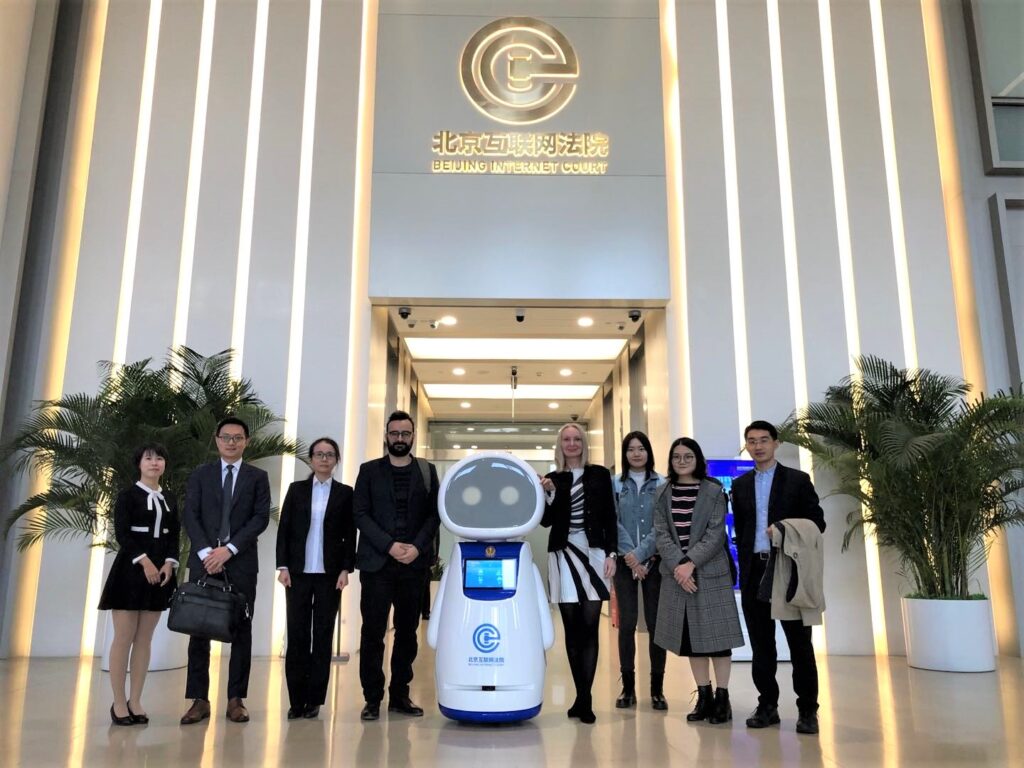
“Hello, I am a robot guide Xiaoyu. How may I help you?” Litigation service halls of many courts in China have introduced robot guides who, equipped with knowledge on the court, legal consultation service, real-time query of case information, help reduce the service workload of staff.
In recent years, digitalization of courts has been explored actively in theory and practice in China. Mostly referring to “smart court” or “intelligent court”, the digitalization of courts means that litigation activities from case-filing, to court trials be carried out online, with the help of modern technology like big data, cloud computing and artificial intelligence. The effects of the COVID-19 pandemic further spurred the need to accelerate the digitalization of the administration of justice and streamline case handling within the sprawling court system in China. Junlin Peng and Wen Xiang ‘s latest paper in the Nordic Journal for Law and Social Research (available here) elaborates the opportunities and challenges associated with digitalization of courts and provides suggestions based on the analysis.
A large number of cases needs to be dealt with by a relatively small number of judges in China: With the rapid development of economy and a growing awareness of rights and obligations, people increasingly resort to law to solve their disputes. The notorious overload of cases and the lack of capacity inevitably affects the quality and efficiency of case-handling. Moreover, traditional ways of collecting, collating and delivering information undermine judicial efficiency. Therefore, the digitalization of courts is expected to contribute to the following: improving judicial efficiency, contributing to judicial transparency, providing convenient services and establishing judicial big data. However, challenges emerge. For instance, how to set the scope of application of technology? Do remote trials violate the Principle of Direct and Verbal Trial? How can electronic services ensure a fair procedure and the litigants’ right to know? This paper shows that some achievements have been made, but court digitalization is still in its infancy in China. It is a phenomenon where practice precedes law, which means there lacks of legislative support and legal theoretical research on informatization of courts. Technological innovations and the scope of their applications require further debate, or else will undermine the legitimacy of digital judiciary.
In particular, the following applications are observed:
Electronic case-filing
According to Article 14 of the Supreme People’s Court’s Rules on Several Issues on Case-filing Registration System, in order to facilitate litigants to exercise litigious rights, courts provide litigation services such as case-filing online systems. So far, many courts in China have actively explored and established an E-filing system, which enables clients to conveniently file a case online. The main concern about E-filing is false litigation. Judges have voiced their concern that they cannot verify the identification of parties and censor the authenticity of litigation materials, leading to an abuse of litigation rights.
Remote trial
Legislation on remote trial is limited. Article 259 of Judicial Interpretation of Civil Procedure Law of People’s Republic of China (hereinafter referred to as Interpretation of Civil Procedure Law) stipulates that for simplified procedures (简易程序), with the consent of both parties and permission of the People’s Court, the audiovisual transmission technology may be used to hold a court session. According to Article 73 of Civil Procedure Law, with the permission of the People’s Court, witnesses may testify through audiovisual transmission technology under the following circumstances: inability to attend court due to health reasons, traffic inconvenience, and force majeure such as natural disasters and other valid causes. However, there is no provision relevant to remote trial in Criminal Procedure Law.
At present, practices of remote trial across the country are pioneering endeavours with little legislative support and theoretical research. Practices of courts in various areas are diverse, we thus observe Jilin Province as an exampl: Jilin e-court is equipped with a cloud conference system which can be used for remote trial in case where litigants, witnesses and appraisers cannot go to the court. Before the beginning of the trial, the litigants are expected to log on to the website of Jilin e-court and enter into the cloud conference system at appointed time. The judge will initiate the cloud conference on the court intranet. There are no strict limits for the types of cases which remote trials may be used for. In practice, it is mainly applied in for simplified procedures (简易程序) and in first instance trials of ordinary and special procedures. In addition, there is no need for both parties to reach an agreement on whether or not to conduct the trial remotely; either party can apply for a remote trial. Thus, one party can participate in court trial through cloud conference system and the other party may go to the court to attend the trial in the traditional way.
Intelligent execution
In China, 80%-90% of the cases of judicial corruption appear in the field of execution, and 80%-90% of corruption in the field of execution appears in judicial auctions. If the parties waive the right to choose an auction agency, the court has the right to entrust one. Driven by high commission interest, the auction agency may distribute 40% of the commission to the judge in order to be entrusted by the court. Besides, the traditional way of judicial auction leads to a limited range of auction information dissemination, so that only a few people obtain auction information and participate. A small number of people participating in judicial auctions and a relative short auction time results in a low hammer price, which impairs the legitimate interests of the creditor and the executed person. In order to eliminate these drawbacks of traditional judicial auctions, courts in Shanghai, Chongqing and Zhejiang are actively exploring online judicial auction (E-auction).
E-auction refers to a model of judicial auction where courts can handle executable property publicly by means of online auction through an auction platform. Among the three models courts across the country experimented with, the model where courts carry out judicial auctions directly on an Internet auction platform without the participation of an auction agency is most widely used. Since June 2012, more than 1400 courts in 28 provinces have independently conducted judicial auctions online, carrying out 250,000 judicial auctions with the value of the executed property amounting to 150 billion RMB. According to Article 12 of Regulations on Judicial Auction Online, the judicial auction online should be announced in advance: the auction of movable property shall be announced 15 days before the auction and auction of immovable property shall be announced 30 days before the auction. To ensure bidders’ full participation in bidding, the Regulations of the Supreme People‘s Court on Issues Concerning Judicial Auction Online (Herein referred as Regulations on Judicial Auction Online) requires that the bidding time is no less than 24 hours. Judicial auction online not only lets more people participate in bidding but also furthers the transparency and justice of judicial auction. Article 3 of the Regulations on Judicial Auction Online stipulates that the judicial auction online should be open to the public on the Internet auction platform and be subject to social supervision. With the public being able to supervise the entire auction process online, doubts concerning the fairness of the auction can be eliminated to some extent.
Wen Xiang (corresponding author) is an Assistant Professor and S.C.Van Fellow of Chinese Law at iCourts (Centre of Excellence for International Courts), Faculty of Law, University of Copenhagen. Wen Xiang was a guest lecturer at Harvard Kennedy School and a visiting scholar at Duke University School of Law. Contact him on LinkedIn.
Junlin Peng obtained a bachelor degree in law from Beijing Normal University and a master degree in law from University of Copenhagen. She attended summer school of Georgetown University and exchanged to University of Milan and University of Stockholm. Contact her at junlinpeng[at]163.com.

The Chinese leadership has responded to the growing load of online-shopping related disputes by setting up a special type of court: The Internet Courts (互联网法院) not only specialize in issues brought about through the internet, but also conduct the entire proceedings online.
Since 2017, the Internet Courts in Hangzhou, Guangzhou and Beijing enable litigants to file a claim, attend the hearing, and receive the judgment all without needing to go to a court (check out the pioneer among them, the Hangzhou Internet Court, here). These digital courtrooms may be frequented for certain administrative and civil cases, such as lawsuits regarding sales contracts, including product liability matters, services and loans.
In his recent analysis, Max Planck Institute’s Benjamin Knut Pißler finds the Internet Courts to be a useful new tool in the hands of consumers to secure their rights. This new type of court, which ist likely to be replicated in several other cities in China in the near future, constitute the latest innovation in a rather young field of law in China with surging importance: costumer rights protection. As an addition to the legal mechanisms developed in the past decades, namely the individual actions, representative actions and public interest litigation, the Internet Courts appear to make lawsuits more accessible for the general public, “File a law suit in only 5 minutes”, as the Hangzhou Court advertises on its website.
However, in his analysis recently published in the German Journal of Chinese Law (article in German), Pißler also identifies fundamental problems. “There are some indications that defendants can avoid the proceedings relatively easily,” he points out, as it is unclear what the consequences are if the defendant does not act upon receiving the electronically transmitted notification that he or she has been sued. The relevant regulations laid down by the Supreme People’s Court leave several questions unanswered, and it remains to be seen whether for example a legal duty to regularly check emails and text messages will arise due to the fact that the Internet Courts rely on such communication channels instead of traditional mail.
Further, it is found that the courts are the result of a decision of the Communist Party and a judicial interpretation of the Supreme People’s Court and thus not created in line with the official procedures for founding courts, including a relevant motion on the part of the Standing Committee of the National People’s Congress.
Apart from their regular judicial adjudication work however, the Internet Courts also provide a field for experimentation with new technologies in court proceedings. As innovative institutions outside of the judicial bureaucracy of traditional courts, the Internet Courts could become the arena where the application of artificial intelligence in court decisions, which is vigorously researched in China, may find a testing zone, Pißler indicates.