Skip to content

European Chinese Law Research Hub

  • Home
  • About Us
  • Follow Us
European Chinese Law Research Hub

Tag: One Country Two Systems

China’s Foreign-Related Rule of Law

14. September 2026
A new report by Frank N. Pieke, Daniel Sprick and Björn Ahl

The report China’s Foreign-Related Rule of Law: Significance, Development and Prospects offers a comprehensive account of one of the most consequential yet least understood developments in contemporary Chinese governance: the emergence of the Foreign-related Rule of Law (FRROL, 涉外法治). Authored by Frank N. Pieke, Daniel Sprick and Björn Ahl, the study examines how China has built a framework of laws, regulations, institutions and judicial practices designed to project Chinese law into foreign-related matters and to shape China’s interface with the international legal order. Its central claim is that FRROL is neither an ad hoc collection of defensive measures nor a simple instrument of “lawfare,” but a coherent, long-term and strategically calibrated extension of the party-led socialist rule of law into the country’s external relations.

The extraterritorial reach of Chinese law is now being felt directly by foreign governments, firms and individuals, yet awareness of FRROL outside China remains strikingly thin. The study sets out to correct this asymmetry of understanding. It maps the conceptual foundations of FRROL in Xi Jinping’s thought on the rule of law; surveys the principal legislation and regulation; traces the uneven domestic and subnational implementation of the framework; and analyses its growing entanglement with foreign policy and international law. In doing so, it positions FRROL as a “semi-permeable membrane” between China and the world, intended not merely to filter out unwanted external influence but actively to set Chinese terms for the facilitation, shaping and control of cross-border interaction.

To understand FRROL, the report argues, one must first grasp the transformation of the Chinese rule of law itself. The study locates FRROL within the broader evolution of “the socialist rule of law with Chinese characteristics” (中国特色社会主义法治) and “comprehensive law-based governance” (全面依法治国). The Xi era has, in the report’s reading, resolved the long-standing tension between the rule of law and the rule of the party by making law a constitutive part of absolute party rule rather than a constraint upon it. This framing matters because it explains the distinctive character of FRROL. It is conceived as the extension of China’s domestic law to foreign-related matters and as an interface with international law, encompassing the extraterritorial application of Chinese domestic law, the application of Chinese law to international actors in China, the domestic application of international law, and the enhancement of China’s influence on international rules and norms. Rather than treating China’s legal order as a failed or incomplete approximation of a Western ideal, the study takes seriously the party’s own claim to have built an alternative substantive rule of law, anchored not in liberal universalism but in the absolute leadership of the party. This move is consequential for the analysis of FRROL, because it allows the authors to read China’s external legal projection as the coherent outward expression of a self-confident domestic legal model rather than as mimicry of Western practice.

The report assembles FRROL as a single, multi-layered system and traces its logic across four levels that prior scholarship has tended to treat separately: the conceptual and institutional architecture; the body of substantive legislation and regulation; subnational and judicial implementation inside China; and the projection of FRROL into foreign policy and international law. Several specific contributions follow from this integrative ambition.

By insisting on the distinction between foreign-related affairs and foreign affairs, and by characterising FRROL as a “semi-permeable membrane”, the report reorients the analysis away from the binary of openness versus closure. FRROL emerges as an instrument of China’s “inward turn” and its move toward a China-centric view of the world, principally concerned with regulating and controlling the impact of foreign entities and connections on China’s national security, governance and development, both at home and across “global China.” This reframing carries explanatory power: it accounts for the otherwise puzzling coexistence of aggressive countermeasures with continued commitments to opening-up and the protection of foreign investors.

The report provides a systematic mapping of the substantive legislative and regulatory corpus that gives FRROL its concrete force. The study notes that there are now over fifty standalone laws and regulations on foreign-related issues, alongside more than 150 laws and regulations in broader fields that contain foreign-related provisions, and it organises this otherwise unwieldy body of law into intelligible domains: the 2023 Law on Foreign Relations as a programmatic “basic law” that sets the tone without itself creating enforceable consequences; the anti-sanctions and blocking-rules architecture; the export-control regime and the unreliable-entity list; foreign-investment screening; merger and acquisition control; and an expansive cybersecurity and data-sovereignty framework with significant extraterritorial reach. The study observes that China is converting instruments of ordinary market ordering, such as anti-unfair-competition and anti-monopoly law, into tools of economic statecraft by attaching to them an explicit mandate to protect Chinese supply chains and national interests, a move that other jurisdictions, where competition law is institutionally constrained and privately enforced, are structurally ill-equipped to reciprocate.

The study offers an institutional analysis that is largely absent from the existing literature. It shows that, despite the establishment of the CCP’s Central Commission for the Comprehensive Rule of Law as Xi Jinping’s intended instrument for driving the legal agenda, the development of FRROL remains dominated in practice by the security and national-security establishment, while the commission itself is under-resourced and institutionally outranked by bodies such as the Central Commission for Politics and Law. The study draws out the consequential disconnect between the foreign-related rule of law and the foreign-policy and foreign-relations establishment, arguing that the institutional separation of foreign-related affairs from foreign affairs is deliberate rather than merely the product of bureaucratic turf wars.

Moreover, the report develops the domestic and subnational dimension of FRROL that other accounts have neglected entirely. Through detailed treatment of provincial and municipal practice, including Zhejiang Province’s “whole-chain working mechanism,” Shanghai and Pudong’s foreign-related legal-service infrastructure, and the Guangdong-Hong Kong-Macao Greater Bay Area as a “one country, two systems, three jurisdictions” laboratory, the study demonstrates that the most tangible implementation of FRROL is occurring below the central level and is driven by local priorities, such as protecting overseas investments, resolving trade disputes and serving overseas populations, that have little to do with the centre’s preoccupation with security and geopolitics.

The study extends the analysis into the domain of foreign policy and international law, where it identifies several distinct models of FRROL-supported security and foreign-policy outreach: a surreptitious model in Western developed countries, a national-security model in Central Asia, a domestic-security model in mainland Southeast Asia, and a geo-strategic model among Pacific island states. Linking FRROL to the Global Security, Global Governance and Belt and Road Initiatives, the report shows how China’s domestic security apparatus is being internationalised, and how legal capacity-building, judicial cooperation and the gradual insertion of Chinese concepts into international institutions form part of a long-term strategy to reform the international order from within rather than to overthrow it.

FRROL, the report concludes, advances a selective and strategic approach: expanding the jurisdictional reach and international visibility of Chinese courts, building networks of judicial cooperation, arbitration and mediation, and cultivating foreign-related legal capacity that advantages Chinese parties while remaining largely compatible with international norms and agreements. This finding challenges accounts that treat FRROL simply as aggressive “lawfare” to be resisted, and it reframes the policy problem from one of confrontation to one of strategic legal positioning.

The full report China’s Foreign-related Rule of Law: Significance, Development and Prospects, China Knowledge Network, 7 July 2026, can be downloaded here.

Frank N. Pieke is Visiting Professor at the East Asian Institute, National University of Singapore and Senior Research Fellow at the Leiden Asian Centre. Daniel Sprick is Senior Lecturer at the Institute of East Asian Studies, University of Cologne. Björn Ahl is Professor and Chair of Chinese Legal Culture at the Institute of East Asian Studies, University of Cologne. With contributions from Chia Shimin, Huang Jia’nan, Li Yao and Shan Wei.

China's Foreign Related Rule of Law (FRROL), General Extraterritorial Jurisdiction, Extraterritorial law, Foreign-related Rule of Law, One Country Two Systems, Socialist Rule of Law with Chinese Characteristics

Hong Kong Between ‘One Country’ and ‘Two Systems’

14. June 2021
A forthcoming book by Larry Catá Backer
Hong Kong Tram with National Security Law Government Campaign (Wikimedia Commons)

Hong Kong Between “One Country” and “Two Systems” examines the battle of ideas that started with the June 2019 anti-extradition law protests and ended with the enactment of the National Security and National Anthem Laws a year later. At the center of these battles was the “One Country, Two Systems” principle. By June 2020, the meaning of that principle was highly contested, with Chinese authorities taking decisive steps to implement their own understanding of the principle and its normative foundations, and the international community taking countermeasures. As events progressed between June 2019 and June 2020, the author devised a series of essays that analytically chronicle the discursive battles that were fought, won and lost. Without an underlying political or polemical agenda, the essays retain the freshness of the moment, reflecting the uncertainties of those times as events unfolded. What was won on the streets of Hong Kong from June to December 2019, namely, the public and physical manifestation of a principled internationalist and liberal democratic narrative of self-determination, and of civil and political rights, was lost by June 2020 within a cage of authoritative legality legitimated through the resurgence of the normative authority of the state and the application of a strong and coherent expression of the principled narrative of its Marxist-Leninist constitutional order. Ironically enough, both political ideologies emerged stronger and more coherent from the conflict, each now better prepared for the next one.

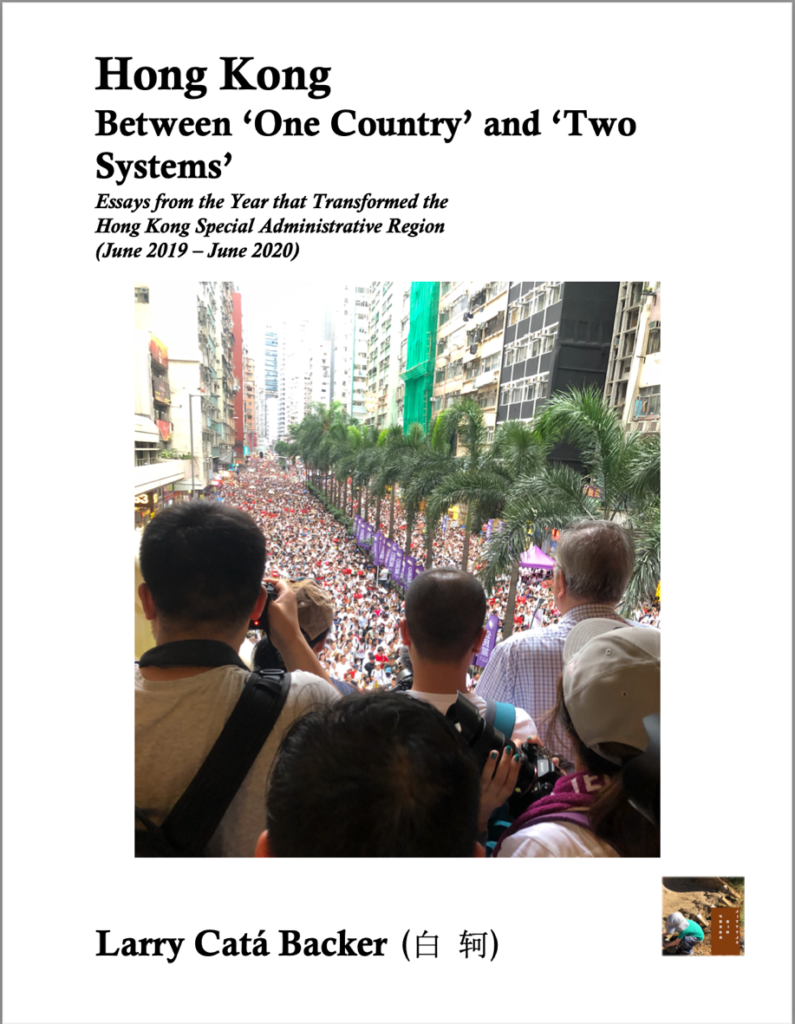
Book Front Cover (Courtesy of the Publisher)

The essays written between June 2019 and June 2020 are compiled in Hong Kong Between “One Country” and “Two Systems” with little change to how they were originally written. The book is presented as a diary with essays as diary entries. This is to mark an intellectual progression that matches the development of Hong Kong’s political turmoil. The object is to capture not just the strategic and normative developments that produced Hong Kong’s new order from June 2020, but also to give a sense of the uncertainties and anticipations that existed leading up that moment. The process of ideological genesis from June 2019 to June 2020 is most immediately captured from a state of anticipation without the benefit of foresight. It is that immediacy that adds a layer of analysis to the usual post facto accounting and examination of events. That layering, anyway, is the aim. The essays in Hong Kong Between “One Country” and “Two Systems”, then, do not look back on events after the fact, but speculate, discover, and capture moments that from June 2020 look inevitable but which from the perspective of June 2019 appeared far less so. By doing so the book aims to retain the freshness of the moment. It is, thus, both a journal of events, and a journey. For its readers it may serve as a record of how the way of thinking about the situation of Hong Kong changed radically over such a short period of time. It is also, in part, a chronicle of the way in which larger events—the US-China trade war, and the COVID19 pandemic—can have a substantial effect on what would otherwise be a localized affair.

The focus of the book is on discourse. The essays follow events as they unfolded through the rhetoric of the parties involved–their statements, their gestures, their performances on the streets, and ultimately the memorialization of these discourses in the landmark laws of the Hong Kong after June 2020–the National Anthem Law and the National Security Law. To some extent this discursive focus owes a debt to and might be comfortably embedded within analytic traditions that owe much to the insights of Guiguzi (鬼谷子) and its rhetoric,[1] which makes its appearance throughout the essays and perhaps binds them together into something more coherent. These insights frame some of the analysis, as do the insights of critical thinkers from the Western tradition.

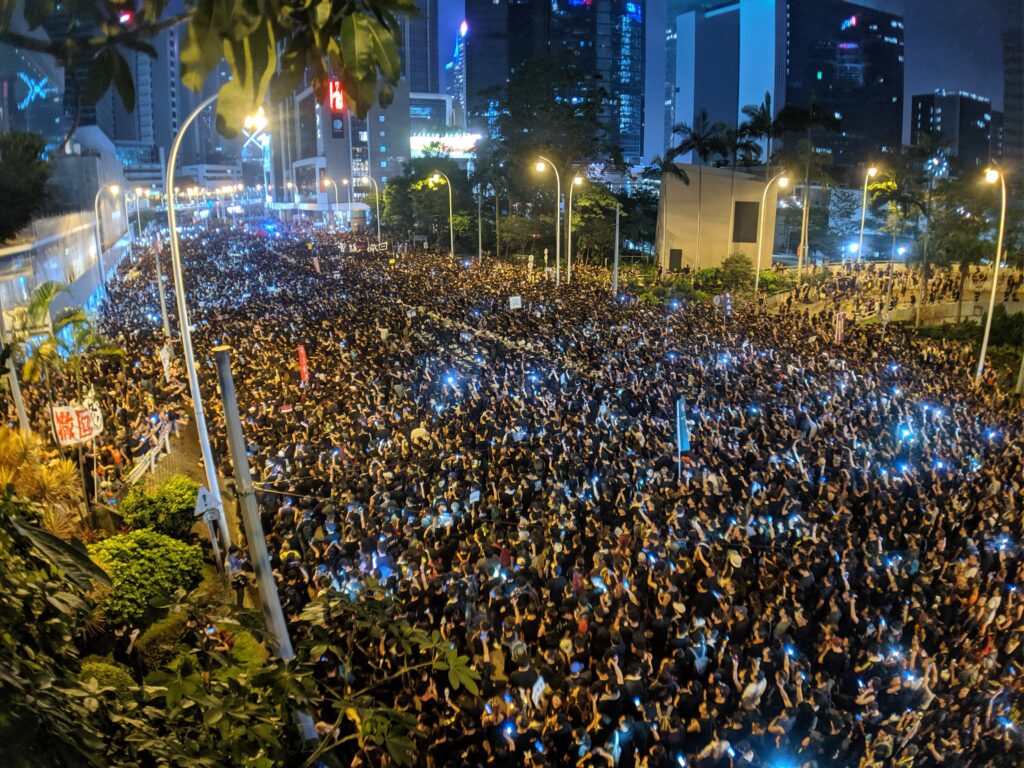
June 2019 protests in Hong Kong (Studio Incendo)

Hong Kong Between “One Country” and “Two Systems” is organized into six parts. Part I (Epilogue as Introduction) starts at the end of the story. It uses a rare statement endorsed by a substantial majority of the representatives of the United Nations Human Rights special procedures calling for the development of decisive measures to protect human rights in the face of the enactment by Chinese authorities of the National Security Law for Hong Kong. This is to situate the story of Hong Kong between June 2019 and June 2020 from the perspective of the international community–perhaps among the actors most adversely affected by the story of Hong Kong.

Part II consists of eleven chapter essays. These essays take the reader from the beginning of the protests in June 2019 to the end of August 2019. The essays serve as an analytical witness to the development of the initial phase of the Hong Kong protests. Step by step, as it occurred, Part II considers the escalations of ambitions and tactics of the protesters, the growing intransigence of local officials, and the start of what would become an elaborate and largely effective counter position of the Chinese central authorities. Much of what occurred during these early weeks provided the foundation for everything that developed thereafter.

Part III consists of seven essays. The essays chronicle critical events taking place from the beginning of September to the end of November 2019. These take the reader through the next phase of development, one in which initial positions are fully developed and hardened. Here one sees fully developed the ideological position of the central authorities that in retrospect were faithfully memorialized in the National Anthem Law, the National Security Law, and recent amendments to the Election rules in the Hong Kong Basic Law in March 2021. At the same time, one encounters here the maturing of an aligned position of the various groups of protesters that sought to deepen the internationalization of their movement and preserve efforts to permanently protect a measure of liberal democratic order in Hong Kong. Lastly, the international response also developed in this period: grounded first in the narrow strictures of the Sino-British Joint Declaration and thereafter in general fundamental principles of self-determination and the international civil and political rights of coherent political communities.

Part IV then considers two stalemates. Firstly, three essays cover the relatively short period of stalemate between December 2019 and April 2020 which includes the apex of protester power in December 2019 and January 2020. Secondly, the stalemate imposed by the realities of the worldwide COVID-19 pandemic. One moves here from the unabated storm of protest to the opportunity that the pandemic provides local and national authorities to break the stalemate in their favor. It was during this period that the stakes around the proper conceptualization of the One Country Two Systems principle became clear. On one side were central authorities who now fully developed the construct of the principle as a means of permitting autonomy within the discretionary authority of the state. On the other were the protesters and the international community who now saw in One Country Two Systems a principle of divided sovereignty in which the political choices of the Hong Kong community could be protected against encroachment by the central authorities, one based on international liberal democratic and human rights principles.

Part V chronicles the end of the protest movement and the emergence of a “new” Hong Kong between May and July 2020. Its seven essays critically chronicle the way that the central authorities drove events from May 2020, in a way that paralleled how protesters drove events between June and September 2019. Part V starts with the announcement of an intention to impose the National Security Law, by first devising the National Anthem Law and then ending with the adoption of the National Security Law itself. The seven essays here consider the importance in developing a patriotic front as a means of dividing and managing the people of Hong Kong, and consider the relatively little opposition that the central authorities faced in realizing their objectives.

The single essay that makes up Part VI serves as the after-word of Hong Kong’s story. Part VI is meant not only to end the story of the protests in Hong Kong but also to begin the story of Hong Kong as a more integrated part of the Pearl River area of China. No longer an international city in the sense of being internationally recognized and having a protected legal autonomy from its territorial sovereign, Hong Kong now rejoins the nation as a Chinese city with substantial international connections. Beyond that, Hong Kong’s future is now far more closely aligned with that of the Chinese heartland and with the vision of China’s central authorities for the nation as a whole.

The publisher, Little Sir Press, will be hosting a book launch author meets reader webinar on 13 July 2021.  Registration is required but free. Free chapters and more about Hong Kong Between ‘One Country’ and ‘Two Systems is available here. 

Larry Catá Backer is the W. Richard and Mary Eshelman Faculty Scholar, Professor of Law and International Affairs at Pennsylvania State University (B.A. Brandeis University; M.P.P. Harvard University Kennedy School of Government; J.D. Columbia University). He researches in the areas of Marxist Leninist political-economic systems with a focus on China and Cuba, economic globalization, corporate social responsibility, international affairs, global governance, trade and finance, and semiotics. In addition to his own books, Backer has published over one hundred articles and book chapters in journals in the U.S., Latin Americas, China, and Europe. For a list of his publications, please click here. Backer also runs his own blog, Law at the End of the Day. 


[1] Guiguzi (鬼谷子), Guiguzi: China’s First Treatise on Rhetoric; A Critical Translation and Commentary (Hui Wu (trans.); Carbondale: Southern Illinois University Press, 2016 (before 220 A.D.))

General Hong Kong, National Security Law, One Country Two Systems

Recent Posts

  • China’s Foreign-Related Rule of Law
  • When Sanctions Meet Blocking Rules: China’s First Prohibition Order
  • The Great Firewall Gets a Passport: How China’s Censorship Travels
  • AI for China’s Courts: Training and Testing for the Socialist Rule of Law
  • Rule by Algorithm: When Code Displaces Law

Tags

Administrative Enforcement Administrative Procedure Anti-Monopoly Law Arbitration Authoritarian Legality Chief Officials Appearance System China International Commercial Court Chinese courts Civil Code Civil Law Civil litigation Communist Party Comparative Law Constitutional Law Contract Law Covid-19 Criminal Law Criminal Procedure Data Protection Democracy Digitalization Foreign-related Rule of Law Government Transparency Guiding Cases Hong Kong Human Rights International Law Judges Judicial Reform Judicial Reforms Labour Law Law and Development Lawyers Legal History Migration One Belt One Road Open Public Data Public International Law Regulation Regulation of AI Rule of Law Smart courts Social Credit System Speech Regulation Supreme People's Court

Subscribe to our newsletter…

...to be the first to learn about new blogposts.

Idealist by NewMediaThemes